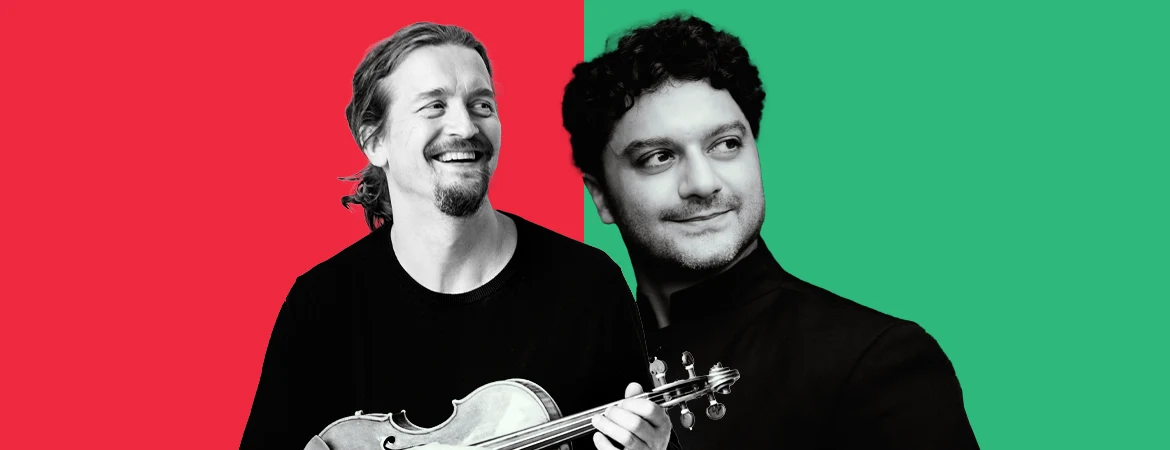
Three titans of 20th-century music — Benjamin Britten, Béla Bartók, and Igor Stravinsky — each redefined the musical landscape in their own way. Britten’s Variations on a Theme of Frank Bridge evoke a wide range of historical idioms in neoclassical style, while Bartók’s Violin Concerto No. 1 acquires a curious sweetness, even sex appeal, when played as flowingly and serenely as Tetzlaff does it (Classics Today).
Stravinsky’s Symphony in Three Movements offers a powerful synthesis of the composer’s rhythmic genius within a classical framework sharpened by modernist edge.
Variations on a Theme by Frank Bridge Op. 10, is one of the works that brought the British composer Benjamin Britten (1913-1976) international recognition. It is dedicated to Britten’s professor who had a significant influence on his work. He began work on the Variations in 1932, before putting it aside, only to return to composing five years later. At the invitation of the Salzburg Festival, Britten was given the opportunity to write a piece in just three months that will be premiered at the festival. He used the second of the Three Idylls for String Quartet, Op. 6 no. 2 by Frank Bridge, and finished the first draft of the piece within ten days. Variations on a Theme by Frank Bridge premiered on August 27, 1937 in Salzburg, followed by the British premiere two months later, after which the piece underwent numerous performances and recordings.
The composer wrote in the score: To F.B. A tribute with affection and admiration. Each variation evokes a specific quality of Bridge’s personality, portrayed through Britten’s creative prism: integrity, energy, charm, wit, tradition, enthusiasm, vitality, compassion, respect, skill and, ultimately, mutual affection. In addition to his own artistic expression, the composer referred in the work to the styles of several authors, among them Rossini, Ravel and Stravinsky.
Béla Bartók’s (1881-1945) Violin Concerto No. 1 was written in 1908. This work, however, was not printed until 1956 and is marked as a posthumous opus,. The concert is testimony to the composer’s unrequited love for the nineteen-year-old violinist Stefi Geyer, who insisted on the work to be performed only after her death. It was premiered in Basel in 1958 by Hansheinz Schneeberger, but was ultimately popularized by David Oistrakh.
The composition is in two movements, which stand in a relationship characteristic of a rhapsody or (which was perhaps closer to Bartok) a traditional folk music diptych (a slow song and a fast dance), but it is essentially a musical portrait of Geyer. The first movement is, according to the composer, an idealized Stefi – heavenly and introspective, and Bartok presents her with an opening motif of five tones in the soloist’s score. The contrapuntal weaving of this movement, based on the variation principle, is complicated by the gradual inclusion of all string instruments, after which the wind corps brings a new, passionate theme. In a letter addressed to the violinist, Bartók admits that this movement came straight from the heart.
The composer then presents the other side of Gejerova – cheerful, witty and amusing, with a fast movement whose initial theme of four accented tones is also connected to the motif of Stefi in inversion. Various transformations of motifs and vivid orchestration, as well as a scherzo character that is linked precisely to folklore dance (later an indispensable part of Bartók’s music) are the characteristics of this free sonata form, on the last page of which the composer paraphrased Béla Balázs’s poem about unrequited love: It is in vain, it is in vain, this song / for me now there is only consolation.
Two years after the completion of the Symphony in C, Igor Stravinsky (1882-1971) received a commission from the New York Philharmonic to write a new symphonic work. He worked on the Symphony in three movements for three years (1942-45), and the work process was influenced by the circumstances of the war. The composer finally shaped and completed the work during the last days of the war under the influence of, as the composer said, difficult times of sharp and sudden changes, despair and hope, constant torment, tension and, finally, calm and relief…
As material for the symphony, Stravinsky used segments of the music he initially wrote for the film version of Franz Werfel’s novel, The Song of Bernadette, which he used to the greatest extent as material for the second movement. As the composer stated, each episode in the Symphony is related to his cinematic impression of the war. So the aggressive first stance was inspired by a war movie about the scorched earth military strategy used in China. In its harshness and fury, this movement is harmonically quite distant from the diatonics that characterize the Symphony in C. Here, the neoclassical form meets the rhythmic intensity of the Rite of Spring. The light and airy second movement puts the harp in a central position, and the seven-bar Interlude leads the musical flow to a finale that Stravinsky described as a reaction to the news and documentaries he watched about military marches. He portrayed the experience of those horrific scenes using a marching rhythm and instrumentation that included brass instruments, accompanied by a grotesque crescendo of the tuba. The exposition of the fugue at the end of the symphony is related to the rise of the allies and hence the use of a triumphant final chord that is spread over even more than six octaves in different orchestral sections. The Belgrade Philharmonic Orchestra performed Igor Stravinsky’s Symphony in Three Movements for the first time in 1962.
Asja Radonjić, M.Sc