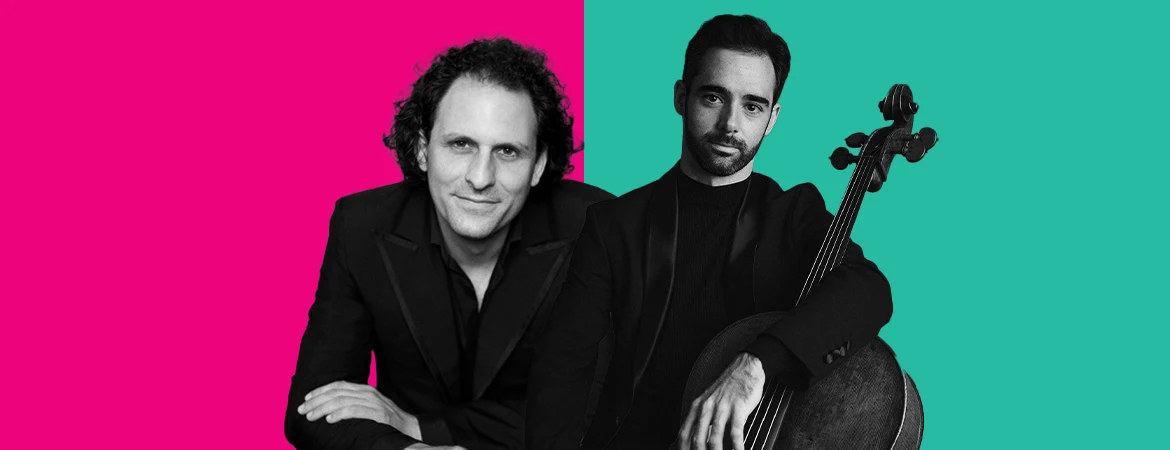
The Belgrade Philharmonic Orchestra opens the new season with two exciting debuts: the renowned French conductor Alexandre Bloch and the new cello prodigy Pablo Ferrández, performing on the 1689 Archinto Stradivarius.
The program features Witold Lutosławski’s Concerto for Orchestra, rooted in the melodies of Polish folk music, Camille Saint-Saëns’ Cello Concerto No. 1, one of the crown jewels of cello literature, and Igor Stravinsky’s vividly colorful suite from the ballet Firebird.
The Concerto for Orchestra by Witold Lutosławski (1913-1994) is one of the most significant works of Polish music of the 20th century and a key achievement in the composer’s early style. It was written at the request of the music director of the newly formed Warsaw Philharmonic Orchestra, Witold Rowicki, and represents a combination of traditional form, contemporary harmonic solutions and inspiration from Polish folklore, especially from the Masovia region.
Using the potential of a large symphony orchestra, Lutosławski, undoubtedly inspired by Bartók’s work of the same name, masterfully created a rich, dramatic and rhythmically lively sound in his work. The way in which he uses folk themes is striking – not as direct quotations, but as the basis for complex and original variations. With its energy, virtuosity, and formal clarity, the Concerto for Orchestra reflects the composer’s aspiration for an artistic expression that would be both contemporary and nationally tinged, despite the constraints of socialist realism of the time.
The work achieved great success upon its premiere and helped Lutosławski establish himself as a leading figure in Polish music. It also represents a turning point in his career, after which he would gradually move towards more avant-garde techniques that would mark his mature style.
The concerto deviates from conventions in terms of form, as none of the movements follows sonata form at all. The structure of the opening movement, called Intrada, is in three movements with variations, with the entire first section performed above the pedal in the key of F sharp – the center of the piece’s tonality. Same as the final section, it is based on a rhythmically emphasized motif that is transferred from one group of instruments to another, with a gradually more complex texture, while the central section is significantly more diverse in terms of motivic material. The recapitulation provides a very concise, quiet reminiscence of the opening section, with the F sharp pedal now heard in a high register. The second movement begins with the Nocturne Capriccio, a fast and colorful section of airy texture with prominent solo moments. It is contrasted by a short dramatic Arioso, followed by a short recapitulation of the opening section. The dramatic focus of the work is the third movement. During the opening Passacaglia, a line in a deep register begun by the double basses is presented twelve times in a variation technique. The layered structures do not necessarily coincide with the main theme, which is cyclical (its end being the same as its beginning). The fiery Toccata displays a pinnacle of technical expression with its layered rhythms and broken phrases. The chorale begins to emerge from it and grows into a rich orchestral sound, and its final section is a reminder of the passacaglia theme in an energetic finale.
The Cello Concerto No. 1 in A minor, Op. 33 by Camille Saint-Saëns (1835-1921) was composed in 1872 and was written for the Belgian cellist, instrument builder and viola da gamba player, Auguste Tolbeck. The work was premiered on 19 January 1873, at a concert by the leading French concert society at the French Conservatoire.
In writing this piece, Saint-Saëns abandoned the traditional concertante form and resorted to a single-movement structure, which he then divided into three distinct sections, interconnected by related ideas. The very beginning of the concerto is already unusual. Instead of a traditional orchestral exposition, the piece begins with a short chord in the orchestral section, after which the soloist immediately enters, presenting the main motif of the piece. The accompanying themes intertwine in the solo and orchestral sections, and then a short minuet appears, which also contains a cello cadenza. The reprise of the opening theme marks the beginning of the finale, which recapitulates the earlier motifs, and at the very end introduces completely new material in the solo section. The composer often uses the solo cello as a declamatory instrument, which puts it in the foreground dramatically and musically, while the orchestra has the role of accompaniment. Despite being technically and musically very demanding for the soloist, this concerto is one of the most beloved works in the repertoire of virtuoso cellists.
Igor Stravinsky’s (1882-1971) ballet, The Firebird, was composed in 1909 and is part of the composer’s early creative work. It is based on a Russian folk tale about a magical bird that is both a blessing and a curse for its owner. Choreographed by Mikhail Fokine, the ballet was premiered by Sergei Diaghilev’s Ballets Russes in Paris on June 25, 1910, as one of the first works written specifically for the company. The Firebird’s historical significance lies not only in establishing Stravinsky as a composer, but also in the fact that it marked the beginning of a collaboration between him and Diaghilev that would later result in masterpieces such as Petrushka and The Rite of Spring. The Firebird represented the end of the era of romanticism and the beginning of the modern age in music. The innovative orchestration was a step forward from the tradition of Rimsky-Korsakov, and the bold rhythmic and harmonic solutions resulted in vivid musical images.
The hero of the story is Prince Ivan who, following the Firebird, enters the magical garden of the evil Kashchei the Immortal. Wandering through the garden, he catches the Firebird, which begs him to spare its life and agrees to Ivan’s request to help him in exchange for his freedom. Ivan sees thirteen princesses and, falling in love with one of them, decides to confront Kashchei and ask for her hand in marriage. After the two clash, Kashchei sends magical creatures to destroy Ivan. The Firebird, true to its vow, enchants the creatures, forcing them to dance. Kashchei and his magical creatures fall asleep, but Kashchei wakes up, and the Firebird kills him. With Kashchei gone, the spell is broken and the magical creatures and the entire palace disappear. All the human beings, including the princesses, awaken, and with the final appearance of the Firebird, they celebrate their victory.
There are several versions of The Firebird. In addition to the complete score of the ballet from 1909–10. In 1911, Stravinsky arranged orchestral suites dating from 1911, 1919, and 1945 for concert performance. Tonight’s concert program features the 1919 version.
Danica Maksimović